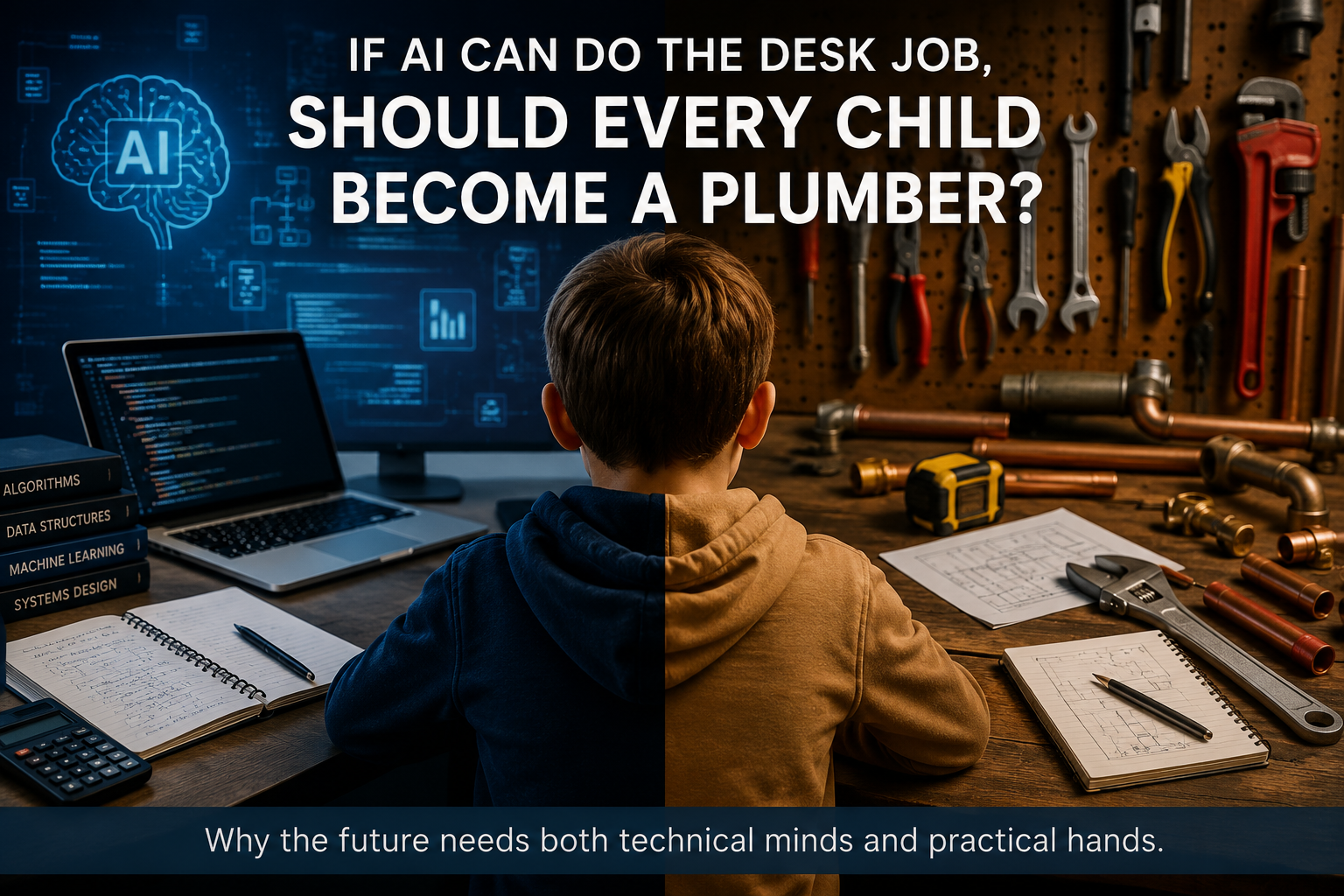
I’m a dad, and I’m a teacher. That means I spend a lot of time thinking about the world my children are actually going to live in, not the one schools were designed for.
And lately, I keep seeing a new piece of career advice gaining traction:
Learn a trade. Become a plumber. Become an electrician. Do something AI cannot replace.
On one level, I understand it.
This is not just something people are saying in WhatsApp groups or on LinkedIn. Reuters recently reported that some young people in Britain are shifting towards skilled trades because they fear AI will damage white-collar careers. The article focused on students choosing plumbing, electrical work and construction because those jobs feel more secure in an AI-driven labour market.
And honestly, that makes sense.
If a pipe bursts under a sink, ChatGPT or Claude are not going to go crawling into the cupboard with a wrench. If a boiler stops working, Gemini cannot physically turn up, diagnose the system, order the part, reassure the customer, and fix the problem. Skilled trades are real. They are useful. They are often undervalued. And in a world where many screen-based jobs are being shaken by AI, they can look very attractive.
There is also real demand. The CITB Construction Workforce Outlook estimates that the UK construction industry will need an average of 41,200 extra workers each year between 2026 and 2030, around 206,000 additional workers over five years.
So let’s get this out of the way: I am not arguing against trades.
In fact, I think practical skills, engineering skills, repair skills, building skills, and hands-on problem-solving should have a much higher status in education than they currently do.
But here is the uncomfortable question I can’t shake:
If everyone retreats from technical thinking because of AI, who exactly is going to understand, manage, question, build, and control the AI?
That is where the “just learn a trade” argument becomes dangerous.
Not because plumbing is beneath anyone. It isn’t.
It becomes dangerous when it turns into a softer message that says: don’t bother learning maths deeply, don’t bother learning computing, don’t bother learning how systems work, don’t bother with abstract reasoning, because the machines will do all that.
That is not future-proofing children. That is deskilling them.
My worry is that a sensible concern about job security could quietly become a programme for deskilling the mass population.
The trades argument has some truth in it
There is a sensible version of this argument.
Jobs that involve physical presence, local trust, manual skill, regulation, messy environments, and human judgement are harder to automate than routine desk work.
A plumber, electrician, mechanic, builder, nurse, dentist, hairdresser, chef, or engineer is not just completing a neat digital task. They are working in the real world, with real materials, real people, unpredictable conditions, and consequences if things go wrong.
That matters.
It is also true that some high-paying office jobs are not as safe as people once thought. Tech companies have slowed hiring. Graduate roles are harder to get. Some junior roles are being squeezed. Tasks that once justified a salary — writing basic code, producing a first draft, summarising a document, creating a spreadsheet, answering routine queries — can now be done faster and cheaper with AI.
So I understand why parents are nervous.
I understand why a young person might look at the job market and think: maybe I should do something practical instead.
But the problem is not practical work.
The problem is the false choice.
The future is not “trades versus technology”
The better question is not:
Should my child learn a trade or learn technology?
The better question is:
What kind of person will be powerful in a world where technology is everywhere?
Because the strongest plumber of the future will not just be good with pipes. They must also understand smart heating systems, sensors, energy efficiency, quoting software, customer acquisition, AI-assisted diagnostics, small business finance, and online reputation.
The strongest electrician will not just wire a house. They must understand solar panels, battery storage, EV chargers, smart homes, automation systems, and how to explain complex choices to customers.
The strongest mechanic will not just replace parts. They must understand electric vehicles, diagnostics, software updates, data logs, and the relationship between physical and digital systems.
And the strongest software engineer will not just write code. They will understand real problems, real users, real systems, risk, ethics, communication, and how to use AI without being fooled by it.
So this is not about choosing between the hand and the brain.
It is about refusing to separate them.
Tech is not dead. Low-level routine work is being squeezed.
One of the mistakes in this debate is that people jump from “some tech workers are being made redundant” to “technology careers are finished.”
That is far too simplistic.
A better UK way to make the point is not to import a US statistic about software developers and plumbers. The UK Government’s AI Skills for Life and Work projections suggest that jobs directly involving AI activities could rise from 158,000 in 2024 to 3.9 million by 2035. The same report identifies programmers and software developers as one of the roles where AI-related growth is expected, and puts programmers and software development professionals at the top of its AI-related net requirement table, at around 555,000 roles through 2035.
That does not mean every junior coder is safe. They are not.
But it does show that the real story is not “tech disappears and trades win.”
The real story is that routine work is being squeezed across many areas, while people with judgement, systems thinking, technical understanding and practical problem-solving become more valuable.
AI does not remove the need for technical people.
It raises the standard.
AI makes shallow knowledge weaker, not deep knowledge
This is the part I think schools and parents need to be very careful about.
AI does not mean knowledge no longer matters.
It means shallow knowledge is easier to fake.
A child can now produce an essay without understanding the topic. A student can generate code without understanding the logic. An adult can create a business plan without understanding the numbers. A worker can send a polished email without understanding the problem.
That is not intelligence.
That is output.
And if education becomes mainly about producing output, then yes, AI will replace a lot of what we currently train children to do.
But deep knowledge becomes more important, not less.
Because someone still has to ask:
- Does this answer make sense?
- What assumptions is it making?
- What has been left out?
- Is the data reliable?
- Is the conclusion justified?
- What happens if the situation changes?
- Where could this fail?
- Who is responsible if it goes wrong?
That is the real skill.
Not typing. Not memorising. Not producing neat work. Not looking clever.
Judgement.
Who supervises the machine?
This is the question I keep coming back to.
A calculator gives you a number. AI gives you something more dangerous: a confident explanation.
It can sound fluent. It can sound balanced. It can sound professional. It can be completely wrong.
So who supervises it?
Not someone who has avoided maths.
Not someone who has avoided computing.
Not someone who thinks technology is magic.
Not someone who can only press buttons but cannot question what comes back.
This is why the skills-gap evidence matters. The UK Government’s AI Labour Market Survey 2025 found that 97% of respondents identified at least one skills gap in the AI labour market, and 57% of businesses reported a technical skills gap. The biggest gap was understanding AI concepts and algorithms.
In plain English, even the organisations trying to use AI are saying they do not have enough people who understand it properly.
That should worry us.
Because if we tell ordinary children that technical understanding is only for a small elite, then we should not be surprised when a small elite ends up controlling the systems everyone else depends on.
That is the real risk.
Not that every child fails to become a software engineer.
The risk is that most children become passive users of systems they do not understand.
This could create a two-tier society
One group will understand the tools.
They will build them, own them, improve them, regulate them, exploit them, and profit from them.
Another group will merely use them.
They will be told what the system says. They will accept the recommendation. They will follow the automated process. They will be managed by dashboards, algorithms, scoring systems, and AI-generated decisions they cannot properly challenge.
That is not a small educational issue.
That is a power issue.
Because mathematics, computing, literacy, and scientific thinking are not just school subjects. They are ways of seeing through the world.
They help a person ask better questions.
They help a person notice when something does not add up.
They help a person avoid being impressed by nonsense.
They help a person remain free.
So what should we teach?
I think the answer is not to double down on the old model, where children spend years performing procedures that machines can already do.
But it is also not to abandon technical education and send everyone into “safe” jobs.
We need something better.
Children need strong fundamentals. They need number sense. They need logic. They need to write clearly. They need to read carefully. They need to understand data. They need to learn how computers work. They need to build things. They need to solve real problems.
They should use calculators.
They should use AI.
They should also learn when not to trust them.
They should learn coding, but not because every child must become a coder.
They should learn coding because it teaches precision, structure, debugging, and cause and effect.
They should learn maths, but not because every child needs to do long division by hand forever.
They should learn maths because it teaches them how to reason when the answer is not obvious.
They should learn practical skills, but not as an escape from thinking.
They should learn practical skills as another form of thinking.
The goal is not to beat the machine
Children cannot beat AI at speed, and they should not be trained as if that is the contest.
A child is not going to out-generate a machine that can produce ten answers in seconds. But speed is the wrong game.
They need to become the kind of people who can use powerful tools wisely.
That means combining things schools too often separate:
- maths and making
- coding and communication
- tools and judgement
- technology and ethics
- academic knowledge and real-world application
- hands-on work and abstract thought
The future will not belong simply to people who can do what machines cannot do.
It will belong to people who can decide what machines should do, check whether they have done it properly, and use them to solve problems that matter.
The danger is not that children learn trades. The danger is that we mistake safety for retreat.
To parents
If your child wants to become a plumber, electrician, mechanic, engineer, builder, nurse, chef, designer, or anything practical, encourage it.
But do not let “AI-proof” become an excuse for intellectual retreat.
The best future plumber will still need maths.
The best future electrician will still need technology.
The best future mechanic will still need diagnostic thinking.
The best future entrepreneur will still need to understand systems.
And every child, whatever they do, will need to live in a world shaped by AI.
So the question is not whether your child should learn a trade or learn technology.
The question is whether they are being trained to be a passive user or an intelligent operator.
To teachers
We need to be honest about the world children are entering.
If our curriculum is mainly training children to produce answers that machines can already produce, then we need to change the curriculum.
But if our response to AI is to lower the intellectual ambition for children, then we have failed them.
We should not be preparing children to hide from technology.
We should be preparing them to stand over it.
To question it.
To use it.
To challenge it.
To build with it.
To remain human in the presence of it.
That means the basics still matter, but they matter for a different reason.
The basics are not a race against machines. They are the foundation that lets children supervise, challenge and direct them.
A better question
Instead of asking, “What job will AI not replace?”, I think we should ask:
What kind of person will still have power when AI is everywhere?
My answer is this:
A person who can think clearly, use tools intelligently, solve real problems, work with people, understand systems, and keep learning.
That person might be a plumber.
That person might be a software engineer.
That person might be a teacher, designer, doctor, builder, business owner, scientist, mechanic, or parent.
The job title matters less than the capacity.
The danger is not that children learn trades.
The danger is that we mistake safety for retreat.
AI should not make us teach children less.
It should make us teach them better.
I’d love to hear your view: should schools be doing more to combine maths, computing, AI literacy and practical problem-solving, rather than treating them as separate worlds?